Blog Post
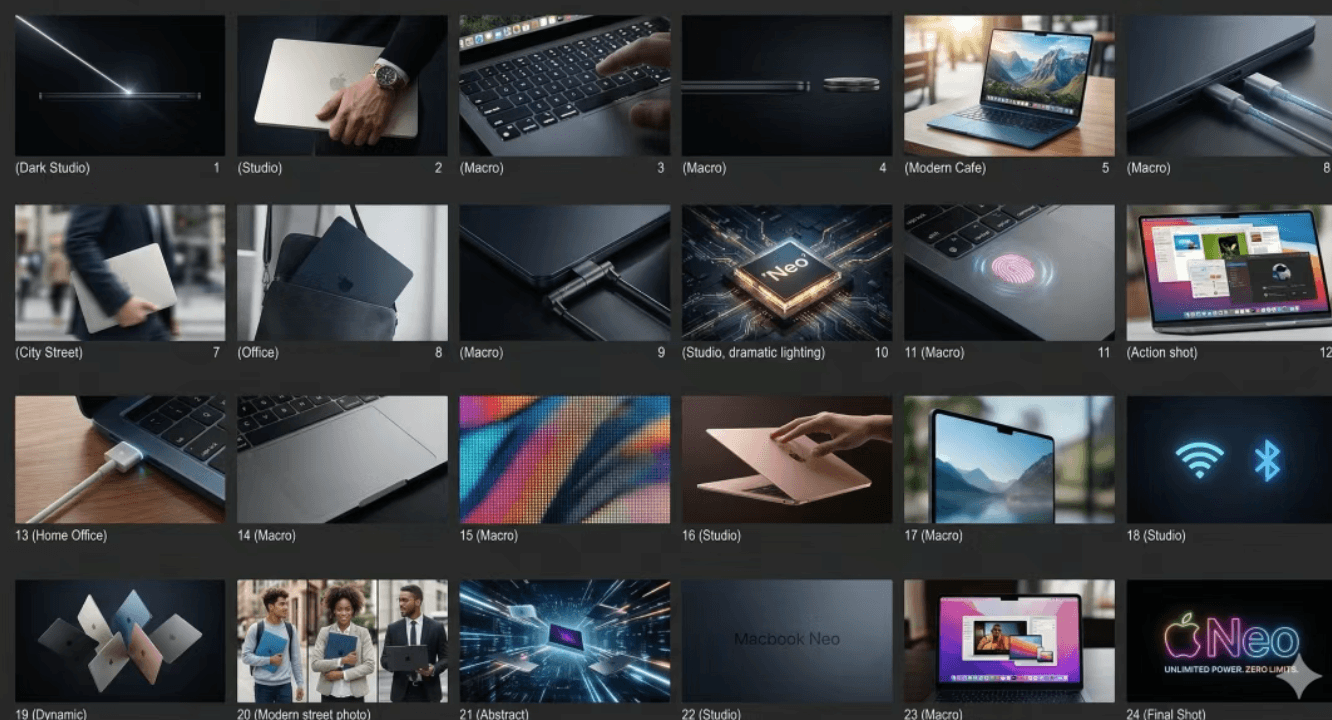
Use Nano Banana like a “design assistant”: storyboards
By Nano Banana Team •
The fastest way to get value from nanobanana2 is to treat it as a design assistant: you write a brief, it drafts options; you review, it revises; you request new sizes, it adapts. For e‑commerce and content production, this can massively increase creative throughput.
1) Generate storyboards in one shot (brief → review)
For landing pages and ads, you don’t want to “write prompts”—you want to describe requirements:
- what you sell (key differentiators)
- who it’s for (persona + pain points)
- how many frames (12 / 24 / 48)
Copyable prompt (grid storyboard):
Generate a [24]-frame advertising storyboard grid for [PRODUCT].
Requirements: photoreal; multiple scenes (indoor/outdoor/close-ups/usage);
highlight selling points: [P1] / [P2] / [P3];
consistent tone: clean, premium, modern; sharp details.
Output: HD.
2) Batch retouching: make 100 images look like one studio shoot
The real win isn’t retouching one image—it’s making 20 SKUs × 5 images share the same look. Lock these:
- background (clean studio)
- edges (crisp), materials (premium), reflections (clean)
- shadow direction and intensity
- color consistency
Copyable prompt (batch retouch):
Batch-retouch the uploaded product images into one consistent style:
clean light-gray studio background; keep product proportions unchanged;
sharper edges; premium material texture without over-smoothing;
clean reflections; consistent shadow direction and strength; consistent color.
Do not alter product details or structure.
3) Multi-size adaptation for campaigns
Most campaigns need multiple ratios:
- 1:1 and 4:5 (feeds)
- 16:9 (banners)
- 8:1 (ultra-wide creatives)
Copyable prompt (extend/adapt ratio):
Extend and adapt this creative to [8:1].
Constraints: do not distort or crop key subject; extend background naturally;
keep copy readable; keep brand palette and hierarchy unchanged.
4) A stable 3-pass production loop
For best stability:
- pass 1: layout and composition
- pass 2: texture / lighting / polish
- pass 3: exact copy, logo placement, final ratios
5) Summary
When your prompt reads like a brief and your iteration reads like review notes, nanobanana2 behaves like a teammate—not a toy.