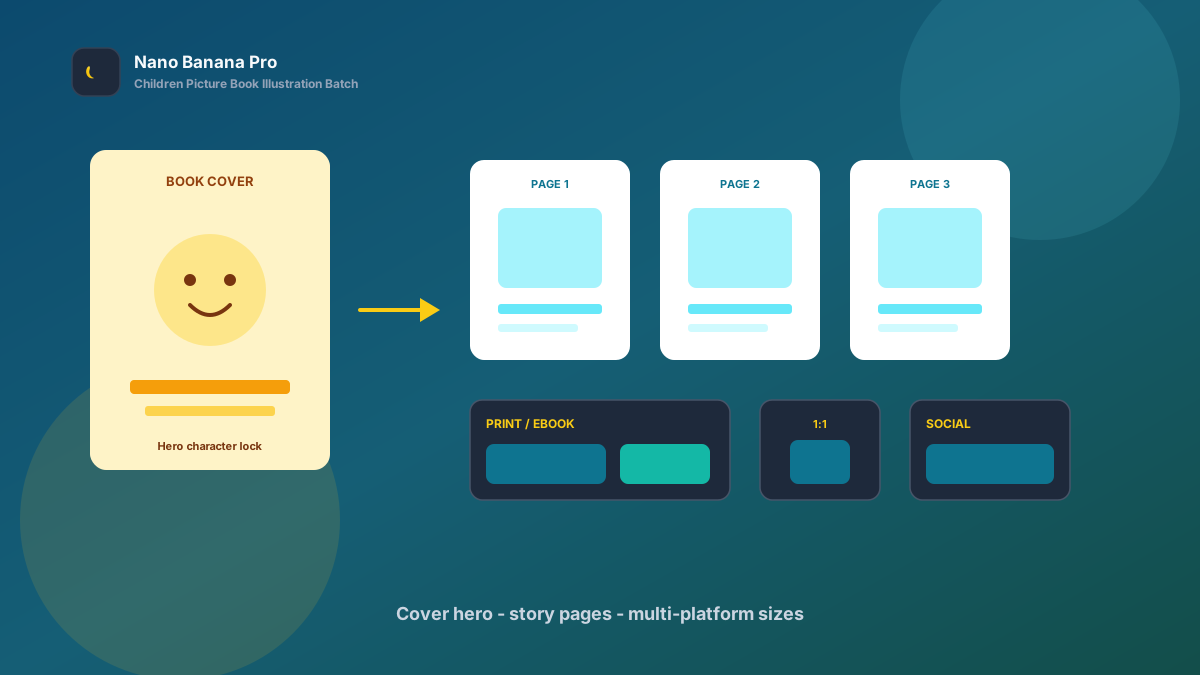
Nano Banana Pro Children's Picture Book Batch Art
Picture-book launches fear one thing most: a warm story dragged down by drifting characters. The cover hero is adorable, but interior pages swap faces and palettes; print, ebook, and short-video teasers also need different ratios. Parents close the preview before the plot begins. Nano Banana Pro with Nano Banana img2img turns “one character reference + three template prompts” into a replicable children’s picture-book illustration and storyboard batch workflow: lock the cover and lead character first, then batch-extend interior pages and multi-platform sizes. This article covers the full SOP.
Why Picture-Book Visuals Must Set the Cover Tone First, Then Layer Interiors?
Many authors “reroll” every page alone, so the cover feels warm, page two goes cold, and the climax uses yet another brush. Readers suspect a collage book. The scientific approach is to lock one high-recognition book cover (Book Hero) and lead character as the visual anchor, then copy the same proportions, palette, and brush language across every interior page.
Nano Banana Pro builds on the fast generation experience of Nano Banana and suits commercial picture-book cases that need cross-page character consistency, clear text safe zones, and readability for both print and screens. Split the flow into three steps—cover tone-setting → interior storyboard extension → print/ebook/social size pack—and you ship like a studio assembly line.
Workflow Overview: One Hero, Three Output Types
Follow strict order: after the cover and lead character are signed off, all interiors and channel images carry similar color temperature and character traits so the book identity does not split. The three prompt templates below can be copied into Nano Banana / Nano Banana Pro—replace [brackets] with your book details.
| Stage | Output Type | Typical Use | Core Constraints |
|---|---|---|---|
| 1 | Book cover Book Hero | Bookstore cover, ecommerce hero, preview first screen | Strong character recognition; title safe zone |
| 2 | Interior storyboard art | Spread pages, climax, ending | Unified style; character recognizable |
| 3 | Multi-platform size pack | Print / ebook / social teaser | Compliant ratios; subject not cropped |
Stage 1: Book Cover (Preview Click-Rate Anchor)
Use for: print covers, ecommerce heroes, ebook covers, and press images.
Key steps:
- Pick the character model sheet or most representative mood board as the reference.
- Generate a vertical cover: lock facial features and costume, reserve title and author safe zones.
- Archive with a version name (e.g.
book-hero-fox-v1.png) as the full-book character reference.
Based on the uploaded character reference, generate a children's picture-book cover: theme [friendship adventure / bedtime story / science primer / emotional growth], stable composition, lead [animal character / child character] centered slightly high;

Lock palette to [warm yellow + teal / cream pink + sky blue / brand primary], brush [soft watercolor / flat illustration / light painterly];
Reserve the top 18% and bottom 20% as title and author safe zones; forbid packing key facial details into text areas;
Quality suitable for print preview and ecommerce heroes, tone consistent with Nano Banana picture-book visual standards: warm, recognizable, series-extendable.
Pro tip: State clearly “character lock” and “title safe zones,” or AI may fill the frame with the face so the title gets crushed. In Nano Banana Pro, img2img from a model sheet keeps character stability far higher than pure txt2img.
Stage 2: Interior Storyboard Extension (Unified Cross-Page Character Tone)
After the cover sets the tone, batch by story beats: opening, conflict, climax, and resolution.
Based on the uploaded book-cover character and palette, process this storyboard beat into a same-book interior illustration: keep [same facial features + same brush], beat [opening / conflict / climax / resolution] distinguishable;

Requirements: match the cover style; forbid a new filter on every page; keep recognizable costume and props; do not casually change age or body proportions;
Composition [horizontal spread / vertical single page], reserve bottom or side for body text, suitable for **Nano Banana Pro** batch storyboard production.
Nano Banana multi-turn dialogue works well for micro-fixes: “sharper ears,” “cleaner background,” “more text whitespace”—faster than rewriting the full prompt. Fix interior order to lift completion rate:
- Book cover: full-book recognition anchor
- Opening 2–3 pages: establish scene and lead
- Conflict and climax: same character, stronger action
- Resolution page: more whitespace for warm copy
Stage 3: Multi-Platform Size Pack (Print, Ebook, Social at Once)
After cover and interiors are locked, extend channel specs—avoid re-cropping per platform and cutting off faces or titles. Prepare at least these per book:
- Vertical cover / interiors: print and ebook
- 1:1 / 4:5: social seeding and Moments-style previews
- 16:9 / 9:16: teaser horizontals and short-video covers
Based on the uploaded book cover, adapt to [target ratio: vertical / 1:1 / 4:5 / 16:9 / 9:16] picture-book promo size;

Strictly preserve character recognition points, main palette, and warm tone; only adjust crop and whitespace by ratio;
[9:16 only] keep face and title clear of the bottom 18% subtitle/button zone;
[16:9 only] keep left-right scene depth; avoid cropping into a cramped close-up;
Output ready for print preview and social, style consistent with Nano Banana picture-book standards.
Brand Consistency: One Book Must Not Look Like Three Books Stitched Together
The most common batch picture-book failure is a new face on every page. When building studio libraries in Nano Banana Pro, lock these habits:
- Same character line: e.g. reuse “orange fox, round ears, blue scarf” throughout
- Same safe-zone rules: reserve fixed areas for title, page numbers, and body text
- Fixed suffix line: “Consistent with Nano Banana picture-book visual standards: stable characters, warm readability, no over-adult look”
For “sketch vs final” comparisons, clearly label Before/After and keep verifiable character model sheets for editors and partners.
Batch Checklist (Countdown to Launch Day)
Count backward from launch day:
| Day | Task | Tool |
|---|---|---|
| D-10 | Lock story beats, character sheet, and palette | Sheet / mood board |
| D-7 | Generate the book cover (Template 1) and lock the look | Nano Banana Pro |
| D-5 | Batch interior storyboards (Template 2) | Nano Banana Pro |
| D-3 | Extend print / ebook / social sizes (Template 3) | Nano Banana |
| D-2 | Type overlay export and print-bleed QA | Design tools |
| D-0 | Publish to ecommerce and sync short-video preview | Promo |
Efficiency reference: Once fluent, a 12–20 page picture-book first draft can finish in about 3–5 days. Teams using Nano Banana Pro shared templates also reduce character fracture from illustrators applying their own brushes.
Case Study: Studio Ready a Friendship Picture Book Visual Pack in 5 Days
An indie picture-book studio needed a friendship-themed story live next week; the freelance illustrator had a scheduling conflict, and old drafts drifted in character faces on mobile previews.
- Input: 3 character sheets + 12-page storyboard outline
- Step 1: Stage 1 template made a warm-yellow cover locking the orange-fox lead
- Step 2: Extended 10 interiors (opening—conflict—resolution) with the same character
- Step 3: Extended 1:1 social art and 9:16 short-video preview covers
- Output: Type-ready print pack, entire pipeline in Nano Banana
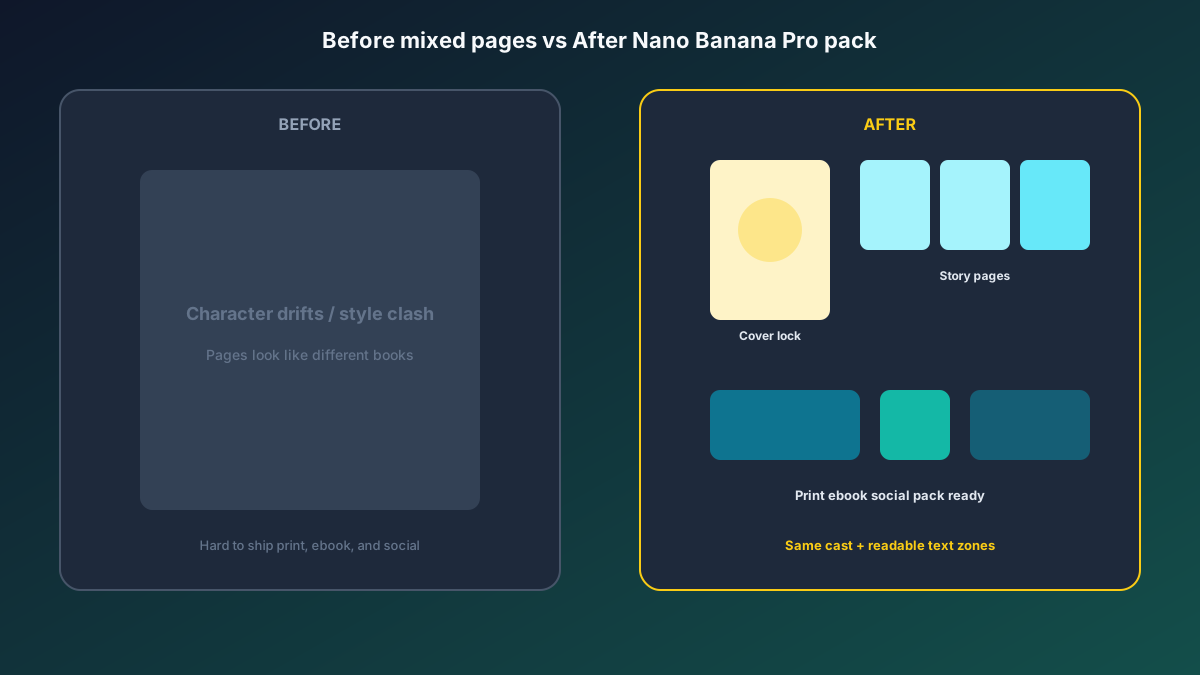
Studio feedback: preview completion rose clearly versus old drafts; parents said “you can spot the character at a glance”; production cost was far below rush freelancers. Structured prompts + stable Nano Banana Pro img2img let the team spend time on copy rhythm and channel promo.
Conclusion: Leave Emotion to the Story, Leave Imaging to the Workflow
Picture-book competition is about cover pull and cross-page trust. When assets shift from “wait for an illustrator slot” to “cover + template extension,” studios catch launch windows faster. Nano Banana Pro and Nano Banana fit as the execution engine for this picture-book SOP—not random face swaps, but helping the same lead be seen more clearly and accompany the whole book more stably.
Before the next draft, lock the cover and character first, then open the three templates—you will find picture-book batch imaging in Nano Banana as clear and controllable as a storyboard sheet.
FAQ
Q: Will the character face drift so children cannot recognize them?
A: Always keep model-sheet references and state “do not change facial proportions or signature props.” Archive finals with model sheets for review; Nano Banana Pro img2img stays closer to the same character than pure txt2img.
Q: The title covers key expressions after overlay—what then?
A: Emphasize in the prompt “reserve title safe zones.” Spot-check more with type overlays at the cover stage; only then batch interiors.
Q: How should Nano Banana and Nano Banana Pro divide work?
A: Nano Banana Pro for cover sign-off and high-demand character consistency; Nano Banana for interior-series extension and size micro-fixes. Templates are shared—pick the entry by account access.